合并两个有序链表
将两个升序链表合并为一个新的 升序 链表并返回。新链表是通过拼接给定的两个链表的所有节点组成的。
示例 1:
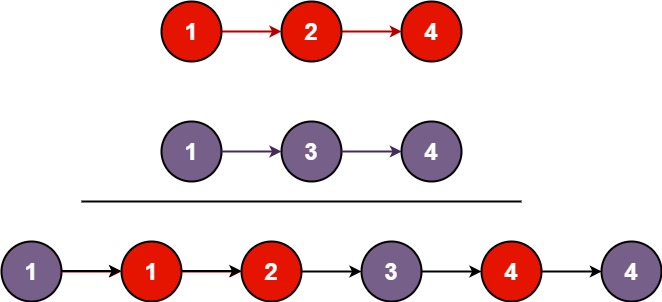
输入:l1 = [1,2,4], l2 = [1,3,4] 输出:[1,1,2,3,4,4] 示例 2:
输入:l1 = [], l2 = [] 输出:[] 示例 3:
输入:l1 = [], l2 = [0] 输出:[0]
进阶做法: 要合并两个升序链表为一个新的升序链表,可以使用递归或迭代的方法。以下是两种方法的详细实现:
方法一:递归法
核心思路:
比较两个链表的当前节点,选择较小的节点作为合并后的头节点,递归处理剩余节点。
步骤:
- 终止条件:若其中一个链表为空,直接返回另一个链表。
- 递归比较:
- 若
list1.val ≤ list2.val,选择list1为头节点,递归合并list1.next和list2。 - 否则,选择
list2为头节点,递归合并list1和list2.next。
- 若
代码实现:
function mergeTwoLists(list1, list2) {
    if (!list1) return list2;
    if (!list2) return list1;

    if (list1.val <= list2.val) {
        list1.next = mergeTwoLists(list1.next, list2);
        return list1;
    } else {
        list2.next = mergeTwoLists(list1, list2.next);
        return list2;
    }
}
复杂度分析:
- 时间复杂度:O(m + n),其中 m 和 n 分别为两个链表的长度。
- 空间复杂度:O(m + n),递归栈深度最大为链表长度之和。
方法二:迭代法(推荐)
核心思路:
使用虚拟头节点(dummy node)和指针遍历,逐个比较两链表节点,按升序连接。
步骤:
- 创建虚拟头节点:用于简化边界处理。
- 遍历两链表:
- 比较当前节点,将较小节点连接到结果链表。
- 移动指针继续比较,直到其中一个链表遍历完毕。
- 连接剩余节点:将另一个链表的剩余部分直接连接到结果链表末尾。
代码实现:
function mergeTwoLists(list1, list2) {
    const dummy = new ListNode(-1); // 虚拟头节点
    let current = dummy;            // 当前指针

    while (list1 && list2) {
        if (list1.val <= list2.val) {
            current.next = list1;
            list1 = list1.next;
        } else {
            current.next = list2;
            list2 = list2.next;
        }
        current = current.next; // 移动当前指针
    }

    // 连接剩余部分
    current.next = list1 || list2;

    return dummy.next; // 返回虚拟头节点的下一个节点(真正的头节点)
}
复杂度分析:
- 时间复杂度:O(m + n),需遍历两链表各一次。
- 空间复杂度:O(1),仅需常数级额外空间。
示例验证
输入链表:
list1:1 → 2 → 4list2:1 → 3 → 4
迭代法过程:
- 初始化:
dummy = -1,current = -1。 - 比较节点:
1 ≤ 1→ 连接list1的1,current → 1,list1 → 2。2 > 1→ 连接list2的1,current → 1 → 1,list2 → 3。2 ≤ 3→ 连接list1的2,current → 1 → 1 → 2,list1 → 4。4 ≤ 3→ 连接list2的3,current → 1 → 1 → 2 → 3,list2 → 4。4 ≤ 4→ 连接list1的4,current → 1 → 1 → 2 → 3 → 4,list1 → null。
- 连接剩余节点:
list2剩余4,连接后结果为1 → 1 → 2 → 3 → 4 → 4。
总结
- 递归法:代码简洁,但可能导致栈溢出,适用于链表较短的场景。
- 迭代法:空间效率更高,推荐使用。